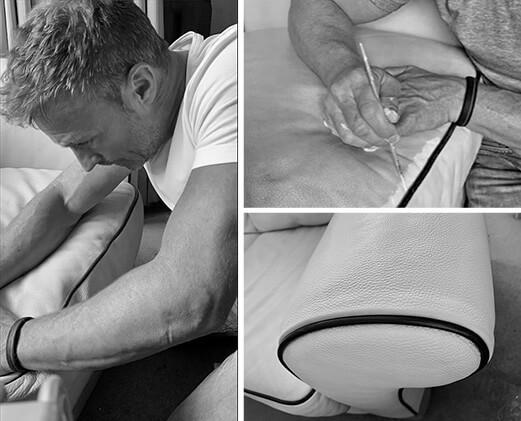
Burn marks on leather can be removed in the vast majority of cases, and the repair is usually invisible once it is finished. A cigarette burn, a scorch from hair straighteners or a melted patch from a hot pan looks dramatic, but it is generally a small, localised injury to the surface of the hide. That makes it one of the more satisfying jobs we do. This post explains what a burn actually does to leather, why the home fixes people reach for make things worse, and what our leather burn mark repair service involves for customers across Essex and London.
What a burn does to a leather sofa or chair
Leather is skin. It does not melt in the way a synthetic fabric does, but heat still changes it. A brief touch from a cigarette or an ember scorches the finish and hardens the top layer of the grain, leaving a small, dark, slightly sunken crater with a ring of discoloured colour around it. A longer contact, such as hair straighteners left face down on an arm or a hot dish put on a footstool, cooks a bigger area. The leather goes stiff and brittle, the pigment blisters or lifts, and sometimes the surface splits.
The ring around the burn matters as much as the burn itself. Heat spreads outward, so there is often a halo where the colour has darkened or the lacquer has dulled even though the leather is intact. A good repair has to deal with that halo, not just fill the hole, or the patch is visible from across the room.
On faux leather and bonded leather the story is different. Those have a plastic coating that genuinely melts, and a burn on them tends to be a hard, shrunken bead with a bigger area of damage than it looks. We can sometimes tidy those, but the honest answer is that the result is rarely as good as it is on real leather.
Where burn marks on leather usually come from
We see the same handful of causes over and over. Cigarettes and roll-ups are still the most common, usually a single small hole on an arm or a seat cushion where somebody sat down with one in their hand. Candles come next, particularly around Christmas, when a tealight gets knocked over or a candle in a glass is set down on a leather footstool. Hair straighteners and curling wands are a growing one, often in a bedroom chair or on the arm of a sofa where someone was getting ready in front of the television.
Then there are the odd ones: a hot iron laid on an armchair for a second, a laptop charger that overheated on a cushion, a log spitting from an open fire in an older house in Rayleigh or Billericay, a barbecue ember blown onto garden room furniture. Jon, our founder, has repaired all of these more than once. The cause does not change the repair much. What matters is the size of the burn, how deep it went, and what sort of leather it is on.

Why home remedies make a burn worse
Burn marks on leather are small and obvious, so people want them gone quickly, and the internet is full of suggestions. Almost all of them turn a small, repairable mark into a larger, harder one.
The most common thing we find is that somebody has tried to cut or sand away the crusty burnt edge. That removes the scorched material, but it also removes the surrounding finish and thins the hide, so the repair area has now doubled in size and the leather around it is weaker. Shoe polish and marker pens are the next favourite. They hide the mark for a day, then rub off onto clothing, and the wax or dye they leave behind stops proper filler and pigment from bonding, which means we have to strip it all back before we can start.
Superglue is the worst of the lot. People use it to stick down a lifted edge or fill the crater. It sets rock hard, goes white, and bonds to the surrounding leather so that it cannot be removed without taking the finish with it. A cigarette burn that would have been a small filler and colour job becomes something closer to a sub-patch repair.
The filler kits sold online for burns and holes are a step up from superglue but still cause problems. The filler is usually too soft or too hard for furniture leather, the colour choices are limited to a handful of shades, and the instructions skip the part about preparing the surface. The result is a patch that is a slightly different colour and texture, sitting in a slightly different plane, and noticeable every time the light comes through the window. Fixing a kit repair costs more than fixing the original burn, because we have to undo the kit first.
What a professional burn repair involves
Our approach to burn marks on leather is the same whether it is a pinhead cigarette mark or a hand-sized scorch, it just scales up. It starts with looking at the burn properly in daylight to see how deep it has gone and whether the grain around it is still sound.
The damaged, brittle material is removed very carefully and the edges of the burn are prepared so that the repair can bond. On a burn that has gone right through, or where the leather has split, a sub-patch is placed underneath to give the repair something to hold on to. The crater is then built up with a flexible leather filler in thin stages, each one dried and levelled, until the surface is flush with the leather around it. Rushing this is what leaves a visible dip or a hump.
Next comes the grain. Plain filler looks like plastic because it has no texture. We re-create the grain pattern of the surrounding leather so that the repair area catches the light in the same way. Then the colour is matched. This is the step that separates a professional repair from a patch job, because leather colour is never a single flat tone. The pigment is built up in layers and blended out into the halo area so there is no edge, and it is finished with a lacquer that matches the sheen of the rest of the sofa.
On a larger burn, or where the halo has changed the colour of a whole arm, we may recolour the entire panel so that everything matches. That crosses over into our leather sofa recolouring work and is still far cheaper than replacing the piece.
When a burn is more than a repair job
There are limits. If the heat has gone all the way through and destroyed a large area, for example a straightener left on for an hour or a chair that caught a genuine flame, the leather in that area is no longer a usable material. The right answer then is to replace the panel, using a matching hide, and colour the surrounding panels so that the new one blends. That is more involved but still routine for us, and we would rather propose it up front than attempt a filler repair that we know will not last.
Anything that has actually been on fire also raises a safety question. Upholstered furniture sold in the UK has to meet fire resistance regulations, and a piece that has been heavily burnt may have had its interlining and foam affected. GOV.UK carries the current guidance on furniture fire safety. If the foam or the frame has been touched by fire, we will tell you honestly whether it is sensible to keep the piece at all.
Time, cost and where the repair is done
Most repairs to burn marks on leather are done at your home in a single visit. A small cigarette burn on a seat cushion is a couple of hours including colour matching and drying time between coats. A larger scorch, or a repair on a very pale or aniline leather where colour blending is more demanding, can take a full day. Where a panel needs replacing, the piece or the cushion normally comes to our workshop in South Benfleet.
The price depends on the size and depth of the burn, the type and colour of the leather, where the burn sits (a flat seat is easier than a piped edge or a button), and whether any previous repair has to be removed first. A single burn on a mid-brown pigmented sofa in Basildon is at the small end. Three burns on a cream aniline armchair in central London that has already been attacked with a filler kit is a different job. Either way, we will look at photos and give you a straight answer and a free quote.
Get a Quote to Repair Burn Marks on Your Leather Furniture
If you have burn marks on leather furniture that you want gone, take two photos: one close up of the burn with something for scale, such as a coin, and one of the whole piece so we can see the leather type and colour. Let us know roughly where you are, whether that is Southend-on-Sea, Chelmsford, Romford or east London, and whether anything has already been applied to the mark.
Call Jon directly on 07967 216250 or fill in the enquiry form below this post. You can read more on our leather burn marks repair page and see examples of what is possible in our wider leather restoration work.