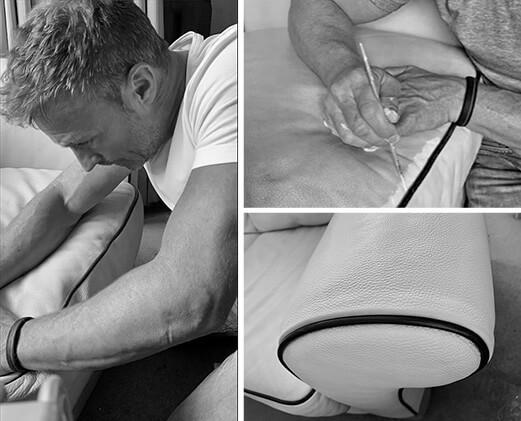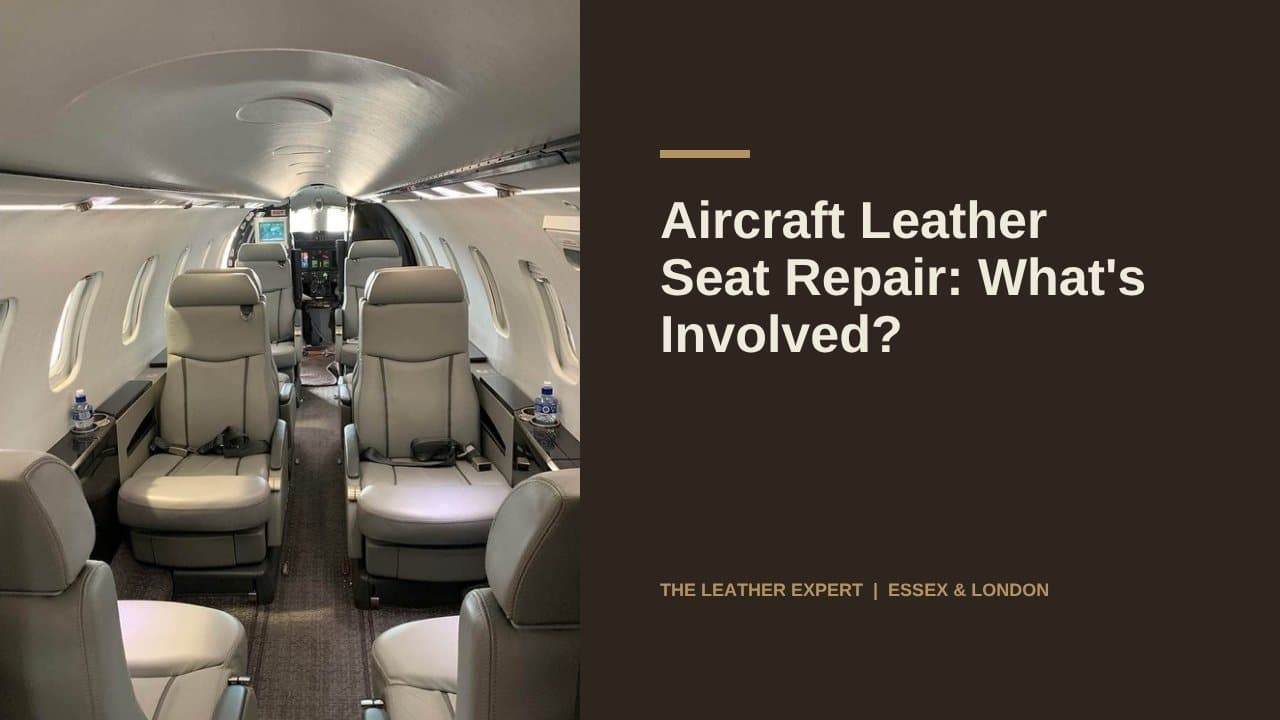
Aircraft leather seat repair is one of the more specialised things we do at The Leather Expert, and it is also one of the most satisfying. A business jet or a well kept light aircraft can have interior leather worth many thousands of pounds, and a single scuffed armrest, a cracked seat bolster or a cabin that has faded unevenly under a few years of high altitude sun can let the whole aircraft down. The good news is that most of that damage can be restored in situ, without stripping the seats out or grounding the aircraft for weeks.
This post explains what is different about aircraft leather, what the common problems are, how our aircraft leather restoration work is carried out, and what to send us if you look after an aircraft based at one of the Essex or London airfields.
Why aircraft leather is not the same as sofa leather
The leather in an aircraft cabin has to meet standards that a sofa never will. It is specified for flammability, smoke and toxicity performance, it is tanned and finished to stay stable through big swings in temperature and cabin pressure, and it is usually thinner and lighter than furniture leather because weight matters on an aircraft. It is also fitted very tightly over shaped foam, with a lot of seams, piping and perforated panels, so the surface is under tension in a way that a sofa cushion is not.
That affects repair in two ways. First, the materials used on the seat have to be compatible with the original finish and must not compromise the fire performance of the interior. Second, any repair has to flex with a surface that is stretched taut and is going to be sat on, leant against and knelt on by passengers who are less careful with someone else’s aircraft than they would be with their own sofa. A filler or colour that would be perfectly fine on a living room chair can crack within a handful of flights on a seat bolster.
The Civil Aviation Authority is the body that oversees UK aircraft maintenance and airworthiness, and while cosmetic leather work does not change an aircraft’s certification, it always needs to be done in a way that respects the materials and standards already in the cabin. That is the frame of mind we bring to every job.
Common problems we are asked to fix
Aircraft seats wear in a predictable pattern. The outboard bolster of every seat takes the brunt of people sliding in and out, so the colour wears through and the surface cracks there first. Armrests darken and go shiny from hands and sleeves, exactly as sofa arms do. Headrests pick up hair product and skin oils. The front edge of the seat cushion creases and eventually cracks where knees bend. Seat belt buckles scratch and gouge the seat pan.

Then there are the one off incidents: a pen leaking on a cream seat, coffee or red wine on a sidewall, a dropped laptop corner, a watch strap catching a seam, a pet carried on board. And there is fading. An aircraft parked on an apron in summer gets a great deal of direct sun through the windows, and cabins that are cream, tan or light grey often end up two tone, darker on the aisle side and bleached on the window side.
On older aircraft we also see general tiredness, where nothing is dramatically wrong but the whole cabin looks ten years old. Jon, our founder, has dealt with all of these, and the approach is different for each.
What aircraft leather seat repair involves
Everything begins with an assessment, ideally on board. We need to see the leather type and finish, the extent of the wear, the condition of the foam and the stitching, and the colour in cabin lighting and daylight. From that we agree the scope: a single seat, a set of bolsters, the whole cabin.
The work itself follows the same logic as any high quality leather restoration but with tighter tolerances. The seats are cleaned thoroughly to remove the build up of oils, cleaning product residue and grime that always sits in the grain of a well used cabin. Cracked and worn areas are prepared, and any breaks in the surface are stabilised and filled with flexible compounds that will move with the leather. Deep scratches and small tears are rebuilt.
Colour is then matched by eye to the existing leather. Aircraft cabins tend to use pale, subtle colours, and pale colours are the hardest to match, because any drift towards pink, yellow or green shows immediately. Jon mixes on site against the seat and tests in a hidden area before committing. The matched colour is applied in fine layers over the repaired and worn areas and blended into the sound leather so there is no visible edge, and where a whole cabin has faded the entire seat set is recoloured for consistency, in much the same way as we would approach leather sofa recolouring on a large suite.
The final stage is a protective top coat that restores the correct sheen, seals the colour and gives the surface a fresh barrier against the next few hundred hours of use. Perforated panels are worked carefully so that the holes stay open and the finish does not bridge them.
Working around the aircraft
We are used to working in a cabin rather than a workshop. That means protecting everything around the seats, working in a confined space, managing curing times, keeping dust and overspray away from avionics and trim, and fitting around the aircraft’s schedule. Most cosmetic repairs are done with the seats in place, which keeps the aircraft available and avoids the cost of removal and refitting. Where a seat needs stitching or panel replacement, that can sometimes be done on board and sometimes needs the seat cover removed.
Repair or reupholster?
A worn cabin does not automatically need new leather. Recolouring and repair can bring most seat sets back to a standard that passes close inspection, at a fraction of the cost and downtime of a full reupholstery, and without the certification questions that new materials can raise. Reupholstery becomes the right answer when the leather has thinned to the point where it is splitting on seams and panels across the cabin, when the foam underneath has collapsed, or when the owner wants a different colour scheme altogether.
Jon will tell you honestly which side of that line an aircraft falls on. It is not in our interest to carry out a repair that will not hold, and it is not in yours to pay for reupholstery you do not need.
Light aircraft and helicopters
Not every job is a business jet. A good deal of our aircraft leather seat repair is on four and six seat piston aircraft and light helicopters, where the seats are smaller, the leather is often thinner and the cabin gets even more sun through a bubble canopy or large side windows. Pilot seats on these aircraft wear on the left bolster and the seat pan from years of climbing in over the wing, and the leather on the door cards and centre console goes with them. The approach is the same, on a smaller scale, and it is a cost effective way of bringing an older aircraft’s interior up to the standard of the rest of the machine before a sale or an annual.
Who we work with
Our aircraft work covers private and business aircraft, helicopters and the occasional vintage aeroplane, for owners, operators, management companies and maintenance organisations. We are based in South Benfleet in south Essex, which puts Southend Airport, Stapleford, North Weald, Biggin Hill and London City within easy reach, and we travel to other airfields across the south east by arrangement.
We approach it the same way we approach our corporate leather restoration work for hotels, offices and retailers: agree the scope, fit around your operation, and leave the leather looking as though nothing was ever wrong with it. Jon’s background includes work for manufacturers and retailers such as Natuzzi, Harrods and John Lewis, and he brings the same standard of colour matching and finishing to a cabin as to a showroom piece.
Get a quote for aircraft leather seat repair
Send us a few photos of the seats: one of each area of damage close up and one of the cabin overall, taken in daylight or with the cabin lights on. Tell us the aircraft type, where it is based and whether there is a window in the schedule you would like the work to fit into. If the cabin has original leather specifications or previous repair records, those are helpful too.
Call Jon on 07967 216250 or fill in the enquiry form below this post. There is more on our aircraft leather restoration page. Every job is quoted individually, and quotes are free.